
CARL EDWARDS
Getting the World and Wanting More
VIDEO TRANSCRIPT
Getting the World and Wanting More
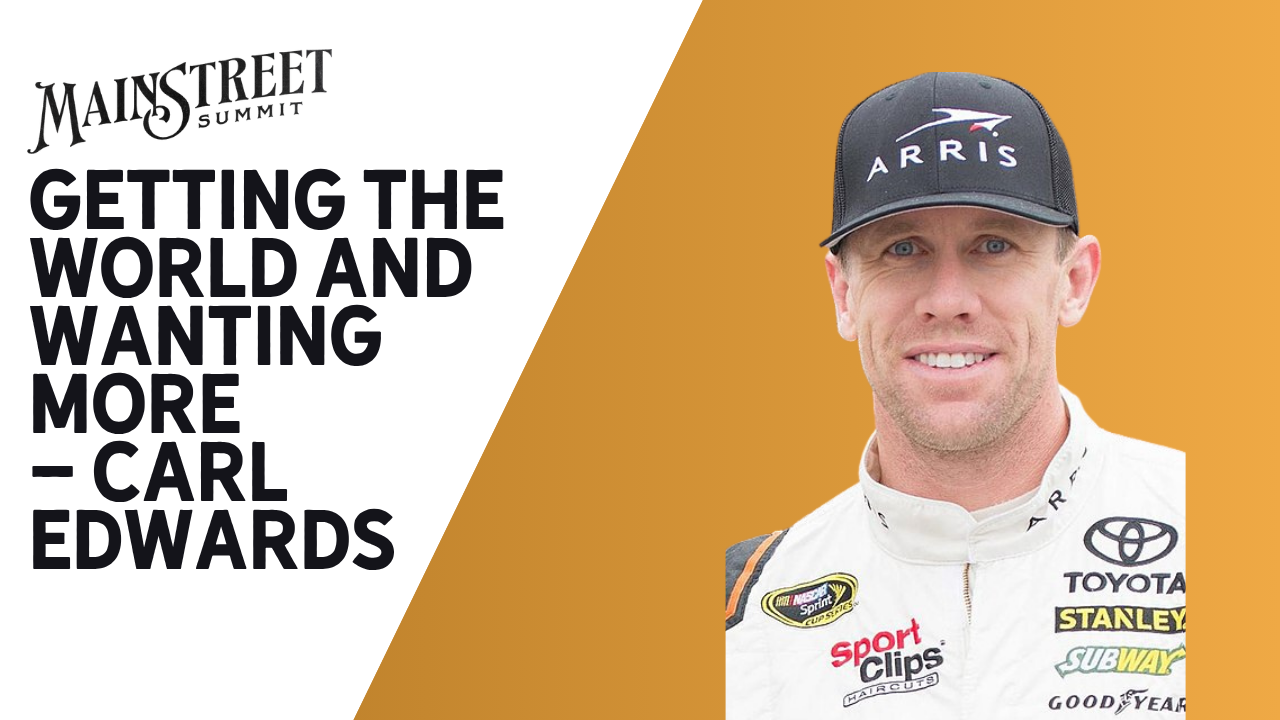
Carl Edwards w/ Brent Beshore at Main Street Summit 2025
Introduction
CARL EDWARDS Okay. I told you I was going to interrupt you at the start. I have to tell you guys a little bit — it’s important. A lot of people have done this, but I don’t care. You need to know who this man is. I don’t think anyone has changed me more than Brent Beshore, and in such a positive way. I’m going to tell you two things — first, how he loves me and how he loves you.
Yesterday morning, you were all walking down the street around 8:45, nine o’clock. Kate, my wife, and I — we were into it over some stuff at home, and it was really stressing me out. I saw Brent coming and I thought, “Ah, there’s my friend.” He said, “Carl, my mom and dad are here and I know how special that is. You’re going to give this big speech.” And then he said, “How are you?” And Brent always says, “I’ve got to be known — no facade.” So I said, “I’m awful. Kate and I aren’t doing well.”
And on the most important day of his year, he stopped to tend to me as a friend. That’s the kind of friend Brent has been. The only other time I’ve seen him anxious about the future was about three weeks ago — fidgeting, standing — worried that someone here might not gain something or have a good time at this event. He cares for you the same way.
Thank you. Thanks for letting me do that.
BRENT BESHORE I can’t believe you did that. I had no idea. All right — now I’m totally thrown off. My codependence is coming out. Now I’m stressed.
How We Met
BRENT So let’s go back to how we met. As all good friendships start, we met in a dystopian book club during COVID.
CARL Yes. When all that stuff shut down, I only had one exciting activity in my life, and that was jiu-jitsu. So I’d go to the gym and get beat up by this one guy every time. He became my mountain that I tried to climb and never did. His name is Justin Dyer. And at some point he must have thought I’d be a great fourth member of the dystopian book club. That’s where I met Brent — during COVID, the super nerds, as I like to call us, talking about dystopian books. That’s how we met.
BRENT And when we met, you had kind of conquered everything — but you were in a season of waiting, is what I’d call it.
CARL Yeah. For me — I don’t exactly know why Brent wants me here, but I know why I want to be here. John Marsh, who’s sitting here somewhere, says you can either impress or empower. The stage of my life you just saw on the screen — I was impressing. But this stage is all about empowering. So my whole point in being here is to give you a little bit of something.
I fought and clawed to be that guy you just saw in victory lane. It was the dream — the most important dream in the world. I was willing to give my life for it, no problem. I was myopically focused on this one thing that I somehow vowed would make me great. And by the grace of God, I realized that wasn’t true. When I met you, I was in a season of searching, and I didn’t know what was to come. But I’m so thankful I was in that season and met you and some of our other friends.
A Columbia, Missouri Boy
BRENT Let’s push pause there, because I want to come back to the beginning. You grew up in Columbia — you’re a Columbia boy. Talk about the circumstances you came out of.
CARL Anybody driving to Kansas City tomorrow can pull off on Business Loop 70 and see my dad’s old shop. It’s a Volkswagen graveyard — it’s super cool, across from the park. My dad was an amazing man, a brilliant man, and his hobby was to build these race cars in his shop and go race them. That really excited me — probably because I wanted to be like my dad. I saw this controlling and uncontrollable thing, and somehow I latched onto this dream of racing.
It’s kind of weird to do that from Columbia, Missouri, because this isn’t a hotbed of car racing. Growing up here, it was this dream I had. Everybody said it was crazy — basically everybody but my mom and my friend Carl Jockey, who I don’t think could make it tonight. And somehow in my soul, I knew it was what I needed to do. It lit me up. It was pure joy.
I chased this thing. And my mother — God bless her. There was a point where I’d won all the races at the local tracks — Holts Summit, Missouri, and Moberly — and I knew we were way behind. If I ever wanted to make a career out of this, we had to move up to these USAC Silver Crown cars. You basically sit in a chair like this with a 700-horsepower engine right against this plant, and on your back, right behind you, 75 gallons of methanol, with the driveshaft running right under your seat. They’re insane to drive. And Jeff Gordon and Tony Stewart and Mario Andretti — all these guys — that’s where they came from. I knew if I could drive one of those, I could make it. I could do this, and the whole world would know.
The problem was I had no business doing it. We did not have the $32,000 for the car. So I sold everything I had — had about 12 or 13,000. I’m living in my mom’s basement. My buddies are driving me around. I’m going to college for 800 bucks a semester. And my mom had $18,000 in her life savings — that’s my mom and dad’s life savings. My dad said no to the race. But my mom took that money — in a brown paper bag — took it to New Franklin, bought this car, and from there, that was really where my career started.
I needed friends. I needed people who believed in me. I needed my mother, and whatever crazy thing was in her head to risk our whole savings on this thing. And that’s the short version of how I made it.
Walking Away at the Top
BRENT Fast forward — when you retired, you shocked the world. I remember it being the headline: no one walks away at the top of their game. So take us to that moment. You’re making an incredible living, you’re on national ad campaigns, on the cover of magazines, and the whole world is saying, “We want more Carl. We want more racing.” You’re literally living your lifelong dream. What was it like to be in that moment?
CARL Let me just pause and say — since I’ve known Brent, I’ve been more vulnerable than ever. This is the first time I’ve talked about some of this this way.
So yes, every dream I had came true. I cannot describe to you the feeling. My brother and I used to go to the mall — it’s a great time, and good for your humility. But the problem is, I started to realize that I really believed in this. It was my God. I was somebody.
And when that facade cracked a little bit around 2008 and ’09 — I did some dumb things, and people started to go, “Hey, is this guy really a good guy?” And I remember thinking, am I really a good guy? I was in love with this thing.
Fast forward — I wrestled with that. 2016 was an amazing year. I drove for Joe Gibbs, the Toyotas were fast, and we won all sorts of races. I was eight laps, perhaps, from winning the championship — the thing I’d worked for, for 20 years, as hard as I could. And it was snatched from us with some circumstances late in the race, mostly my fault. I went home and had a headache for about three weeks.
I’d been thinking about concussions and CTE and what that would do. I’d been gone Thursday, Friday, Saturday, Sunday in a motor home all year. Kate had kind of started — I was coming down the stairs, having a conversation with somebody very close to me, about 30 years older, a very important person in my life. He’s struggling very, very mightily with alcohol. It’s a terrible conversation.
And in that moment, it struck me. I thought: I’m going to go get in that car at Daytona. I don’t know my kids — they’re six, seven years old. I’m going to go hit my head off the wall for another year. I’m going to make millions of dollars, everybody’s going to love it, I’m going to have fun. And then 30 years from now, I’ll be the alcoholic. I’m just going to repeat this process over and over.
And immediately after, I thought — what the hell? What am I saying? I am a race car driver. This is what I do.
It took a couple of days. I thought, I’ve got to go somewhere. I told Kate, “I really am thinking about stopping racing.” She’s like, “Okay, that’s pretty crazy.” I just thought I needed a long walk on a beach somewhere, so I went to Key West. I sat in a hammock, and I had it all planned out — I’ll go to the races, I’ll be more careful, I’ll focus, I can do it all. And I realized on the way home — I fly my plane, I was by myself, about over Missouri — and I thought… I went to Gibbs’ office and said the things I value, and he helped me step away from racing.
It was a little unorthodox. There’s an “Amish Carl” meme on the internet, which is wonderful — they thought I just vanished. You can look it up, Amish Carl is amazing.
But that decision — and this might be applicable to some of you — the thing that was inside of me when I was 18 years old, when I said “it’s worth everything, this thing is worth anything in the world” — it didn’t make sense. Everybody laughed. I remember my first girlfriend; her dad looked at this gravel-floor garage with a four-cylinder Volkswagen race car, and I’m like, “This is what I’m going to do for a living.” And that thing that was in my soul was the same thing, 18 years later, telling me what to do.
The Bahamas, the Border, and “We Deliver Hope”
BRENT So you walk away at the very top. You don’t do media. You go away, you’re in the desert in some ways — wandering. Talk about what you went through. Maybe talk about going down to the Bahamas for some rescue.
CARL I like an adventure. And — I hate to admit this — I like a little risk. Makes for an interesting friendship, as you can imagine.
[Aside — CARL] Can I break for a second? I want to tell you about Brent’s Christmas present to me. We sit down and he says, “Whatever you got” — [laughter] — so Rick, my therapist, is probably here. Sorry, Rick, you’re the one who lost on this whole thing.
So I was lost, and I like adventure. I’d been doing this thing for a while — if there’s a disaster, you’ve got an airplane. There was a hurricane, and I flew a Tampa — maybe Jacksonville — USAR team down to the Bahamas with all their gear. The air traffic controller said, “You can’t go to the Bahamas.” I’m like, “Screw you.” And so we went.
This was a very important step in my life — understanding what it is to be in community. I picked these guys up — they were Gideon Rescue Company — and they had Bibles. We helped some people in the Bahamas; it was pretty rough. The interesting part: the guy sitting in the seat with me, because the plane was packed with all their stuff, we’re talking on the way back to Florida.
We get to Fort Pierce, customs. I’m pilot in command — I’m screwed if anything’s off. The guy goes up first. He stands there and they ask his purpose, and he says, “I’m a citizen on a mission from God.” And the border patrol guy goes, “Go on through.” [laughter]
So I’m like, there’s something going on with these guys. I started going with them, doing things. It took them about a year to explain to me — I’m like, “What kind of generator…” and they said, “We deliver hope. A man can go forty days without food, a week without water, minutes without air — and not a second without hope.”
The Tornado, the Safe, and the Red Camera
CARL I like an adventure, so we kept doing this stuff together. There were tornadoes in Kentucky. I’m not a believer at this time — I’m just cruising along in life. My buddy calls about the tornado: “You got anything you want to bring?” We’d just put tires on our DY truck’s trailer, everything was hooked up. I said, “I guess I could load the skid loader and the Ranger, and we’ll come down.”
Two things happened. We drove around looking for people who needed help. It’s a mile-wide swath of nothing more than two feet tall — everything destroyed. Imagine your neighborhood like that. We go by a house — it says “RIP Mrs. Gaither” sprayed on a plywood board. There’s a bunch of women walking around looking through the rubble. My buddy Mike says — they’d lost her the night before — “We need two things. We need the safe, and we need her red digital camera.”
For about six hours, all day, we’re lifting stuff up looking for a safe. Late in the day, we find something — a little thing underneath it, a little leather camera case. And I said — it’s a red camera. Because that would be invading her privacy, I didn’t open it.
A woman drives up, parks by the foundation. I’m driving a skid loader, watching. She falls to her knees crying. I walk over, and she says, “My mother died. We’ve been asking her for five years to copy these pictures onto something. This is her whole — for the last decade, everything is here. Now we can have a funeral. We can remember my mother.”
In that moment, I realized it’s not about a freaking safe. It’s about the connections we have.
I was done for the day, in tears. I thought we’d done our work — we found the camera, she can have a funeral.
I’ve never seen something happen to a human like I saw that day. I took it as the human spirit. We cleared the man’s driveway and left. About a while later, the man whose house we were at called me. We’d kept in touch. He said, “I was going to kill myself that afternoon, and you guys showed up, and I decided I wouldn’t. You saved my life.”
To find somebody on the fringe — somebody who’s maybe not having a good day — is really, really important.
Friendship, Being Known, and John Marsh
BRENT Let’s talk about friendship. We end up getting a group together and becoming friends.
CARL What do I have to tell you about being known? Here’s one of the hardest — my friends are sitting in the crowd, and they’re very important to me. Brent introduced me to Brent Austin and Trevor. Trevor had an event after this book club, and I argued the merits of evolutionary biology for an hour with Brent. Little did I know he understood that pretty well — he’d humored me. He invited me: “It’s a very special event, and I’d like you to come.”
I do stuff all the time — I’m kind of a big deal in some circles. (That was a pun. I didn’t mean to.) So we go to this event, up on a mountain. And you talk about being vulnerable and being known — John Marsh got up and spoke to the group about the ways Brent has changed his life, and for generations to come. He spoke of him and Ash and their marriage. It shocked my whole view of life. I was a very bad husband. I am not good at loving Kate unconditionally.
We left that. A number of things happened there. I thought, I have to be around John Marsh. We go down the mountain, pick up my son and daughter — Mike and Annie — and my wife. I drop my family off in Missouri.
About a week later, Annie came in — Annie’s pretty — and we were talking about how she might get married someday. I asked, “Why do you want to get married?” She said, “When I sat in the back of the plane last week with the red glasses, I sat and listened for an hour and a half to how a man could love his wife. And I think I want to be a part of something like that.”
For John to be that vulnerable, for you guys to take a chance and invite me up there — it’s changed my life. I’ve never been around men like Patrick and you and Adam and all of our guys — a group of men who’ve allowed me to be vulnerable, to talk about my faults, and to unconditionally love one another. And that started with you.
The Point: Community, and Loving on the Fringe
BRENT I hope you hear that we don’t know what’s going to change lives. I didn’t know how his life was going to change. I didn’t know how my life was going to change. That’s the point I was trying to make this morning. I really think about this as a community — bringing together people who are usually pretty lonely. Being an entrepreneur, being an operator — being married is hard, being a father is hard, being a mother is hard. It’s all hard, and we need to help each other. We’re all so guarded. What I see in Carl and his story is just the ability to go out and see somebody in need. It’s not complicated. There’s no magic to this.
CARL I grew up where it was better to die than to look bad. Period. That’s what was ingrained in me. Like John says, you can’t give what you don’t have. You cannot manufacture love and caring. For me, the thing that’s changed my life is my relationship with our Lord. Ten years ago I wouldn’t have said that. But because I have it, I’m able to give it to others. It’s the most important thing in my life right now.
I can tell you — friendship, family, following what God’s plan is for me — it’s been the most wonderful adventure of the last several years, and I’m so glad to have been on it with you and a number of people in this room.
BRENT Carl, thank you so much. All right, we’re going to end there.
Closing
CARL Stay up here with me before we go — I want to send us off. Cat’s out of the bag: we’re going to have another one of these things. I’d love for you to make at least one friend a day, maybe two a day. My hope is that you get into community, become friends, be known — and bring those people back to Main Street and have them experience this as well. Let’s grow the community with people we’re in relationship with.
So from my family to yours, from my friendships to yours — I hope you go safely home, and we’ll see you next year. Thank you, guys. Appreciate it.
